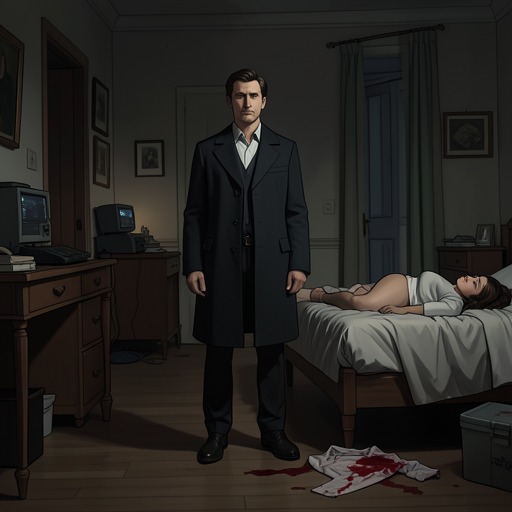
Nash kidnaps Reba Cordova
Hold TightNash kidnaps Reba Cordova in the parking lot of the Palisades Mall, turning an ordinary shopping trip into a carefully coordinated abduction. With Pietra following Reba inside Target and a van positioned beside Reba’s Acura, Nash uses a request for help with a car seat to draw her close. Once she is in his control, he moves her car to confuse anyone tracing her disappearance and threatens Jamie to deter her from escaping.
Setting and Preparation
Nash is already waiting in the parking lot when the scene opens, ready to act. The Palisades Mall in Nyack is presented as a vast commercial landscape: warehouse-style stores, chain bookstores, movie theaters, a Best Buy and Staples, and even a full-size Ferris wheel. Its scale matters to the operation. Reba is one shopper among many, and the space offers the kidnappers a setting in which an encounter can appear mundane rather than conspicuous.
Reba has driven an Aberdeen green Acura MDX and parked far from the entrance. The kidnappers place their van beside it, on the driver’s side. Nash has devised the plan; Pietra is inside Target, maintaining distance while following Reba, and Nash has also entered the store briefly to make a purchase. Their different positions give them separate roles: Pietra tracks Reba’s movements, while Nash prepares the point of contact outside. At the moment captured in the scene, he is waiting for Pietra to text him.
The plan depends on the cars’ arrangement as much as on the timing. Nash has positioned the van’s side door near the Acura’s driver’s side and fiddles with the car seat inside the van, while the Acura’s driver-side mirror allows him to watch Reba approach. The setup makes the van look like the site of a commonplace parenting problem, rather than the center of a planned crime. The mall’s crowds and ordinary errands help conceal the preparations in plain sight.
The Approach
Reba comes out of Target with a red shopping cart and several plastic bags. Nash observes her as she approaches her vehicle, then performs confusion over the car seat and calls her attention to it. His manner is calculated to appear harmless: he stands upright, scratches his head, and offers her a nonthreatening smile. The request turns a stranger’s apparent inconvenience into a reason for Reba to stop and engage with him.
Nash presents himself as a father who has forgotten to transfer a car seat between vehicles. He holds up the manual and asks Reba to take a quick look. She hesitates, registering the instinctive caution the narration associates with an unfamiliar person. But they are in a public parking lot, his explanation seems plausible, and refusing could feel impolite. The pause is brief; she agrees and walks over after putting her shopping bags in the back of her own car.
That decision is the hinge of the abduction. The request offers Reba a familiar, practical task and allows Nash to make proximity seem invited rather than forced. His staged difficulty also shifts attention toward the manual and the car seat, while Pietra remains nearby and Nash can see the surroundings. The narration stresses the reversal between the warning presented by Reba’s hesitation and the social pressure that leads her to help: in this encounter, politeness is made to work against her caution.
Abduction and Immediate Control
Nash directs Reba toward a strap on the car seat and gives her room to look. As she leans into the van, he takes control of the encounter. He incapacitates her, brings her into the van, and closes the side door; Pietra follows and shuts Reba’s car door. The shift from a request for assistance to an abduction occurs within seconds, before the nearby activity provides an obvious interruption.
Nash takes Reba’s keys and uses the remote to lock her Acura. Pietra moves into the van’s driver’s seat and starts it, but Nash stops her and changes the arrangement. He will drive the van; Pietra is to take Reba’s vehicle. He explains that leaving the Acura in the parking lot could identify the place where Reba was taken. Moving it, he reasons, may confuse those trying to establish where she disappeared. The altered getaway plan shows that he is thinking not only about removing Reba but also about complicating the reconstruction of the crime.
Before they leave, Nash secures Reba with plastic cuffs and places a cloth in her mouth. He then invokes Jamie, threatening to take the child if Reba escapes and warning that the consequences would be severe. The threat changes the terms of resistance: Nash uses Reba’s attachment to her child as leverage, and the sound of Jamie’s name stops her from struggling. Pietra is instructed to follow Nash and drive normally, extending the performance of an ordinary journey beyond the parking lot.
Significance of the Scene
The abduction is built from a series of ordinary objects and routines: shopping bags, a car seat, its instruction manual, vehicle keys, and the remote that locks the Acura. Each is incorporated into the plan. The car seat supplies Nash with a credible pretext; the manual sustains the appearance of a request for help; the keys let him relocate Reba’s vehicle. What looks like a small problem between parents becomes the means by which the kidnappers control Reba and manage the scene around her.
The scene also makes concealment a matter of behavior, not simply location. Nash avoids drawing attention by acting as though he needs assistance and later directs Pietra to drive normally. The mall is public, but that visibility does not protect Reba: the request is designed to fit the setting, and the kidnappers rely on the likelihood that bystanders will interpret it as an everyday interaction. Pietra’s separate role and the switch of vehicles further divide the operation into actions that can pass as ordinary on their own.
The decisive consequence is that Reba is removed from the parking lot while her Acura is also moved, obscuring the point of capture. Nash’s threat against Jamie adds a second form of control, aimed not at Reba’s ability to act but at what she might risk by acting. The episode thus establishes both the practical method of the kidnapping and the coercive logic Nash uses to keep Reba from resisting: a fabricated appeal for help opens the encounter, and a threat to her child governs what follows.